


Tax Day Countdown and Important Tax Deadlines!
Learn moreUnderstanding the Differences: S Corp vs LLC
Choosing between an LLC and S corp treatment is really a choice between flexibility, tax strategy, and administrative responsibility. For many U.S. small business owners, an LLC is the starting point because it is a state-created legal structure with liability protection and adaptable management. An S corp, by contrast, is a federal tax election that may reduce payroll-related taxes for qualified businesses, but it also adds rules, filings, and discipline.
What is the real difference between an S corp and an LLC?
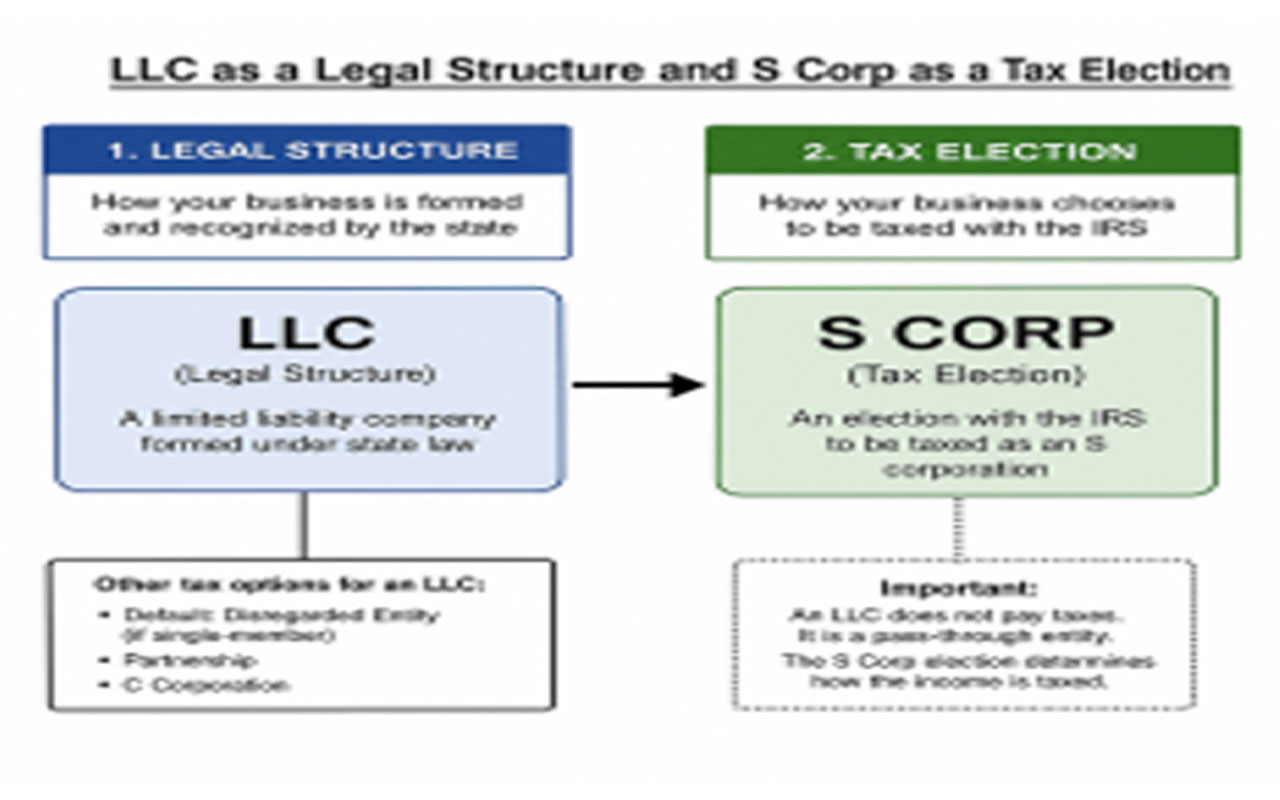
The real difference is that an LLC is a legal business structure, while an S corp is a tax status available to eligible corporations and certain eligible LLCs. An LLC is formed under state law, and the IRS may treat it as a disregarded entity, partnership, or corporation depending on ownership and elections made. An S corporation is a corporation, or eligible entity treated as a corporation, that elects to pass income, losses, deductions, and credits through to shareholders for federal tax purposes. (irs.gov)
That distinction matters because “S corp vs LLC” is not always an either-or decision. A business can form an LLC at the state level and later elect S corporation tax treatment if it qualifies. In everyday planning, the comparison is usually between a default-taxed LLC and an LLC or corporation using S corp tax status.
Tax treatment is usually the deciding factor
Both default-taxed LLCs and S corporations can offer pass-through taxation, meaning business income is generally reported by the owners rather than taxed in the same way as a separate C corporation. The details are different, though, and those details can affect cash flow, payroll, tax filings, and owner compensation.
For a common single-member LLC taxed as a disregarded entity, the owner generally reports business activity on the owner’s tax return, and IRS guidance says the owner is subject to tax on net earnings from self-employment. A multi-member LLC is commonly taxed as a partnership by default, though LLCs may elect a different federal tax classification. (irs.gov)
An S corp uses a salary-plus-distribution model for owner-employees. The IRS says S corporations must pay reasonable compensation to shareholder-employees for services before making non-wage distributions, and it can reclassify distributions as wages when compensation is not reasonable. (irs.gov)
The potential advantage is that wages are subject to payroll taxes, while properly handled S corp distributions may avoid some employment-tax treatment. The tradeoff is that the business must run payroll, file additional tax forms, maintain better records, and support the owner’s salary as reasonable.
A simple tax planning example
Imagine a consulting business with stable profit after expenses. If it remains a default-taxed single-member LLC, the owner may owe self-employment tax on net earnings, subject to applicable rules and limits. If the same business qualifies for S corp status, the owner may pay themselves a reasonable salary through payroll and take remaining profit as distributions, assuming the facts support that split.
This does not automatically mean the S corp saves money. Payroll service costs, tax preparation, bookkeeping, state fees, and compliance time can absorb the benefit. The S corp strategy usually becomes more attractive when profits are consistent enough that a reasonable salary still leaves meaningful distributable profit.
LLCs and S corps differ in flexibility, ownership, and formalities
The llc vs s corp decision is not only about taxes. It also affects who can own the business, how profits are shared, how much paperwork is required, and how easy it is to bring in future investors.
A practical side-by-side comparison looks like this:
● Legal identity:
○ LLC: A state-law entity formed through llc formation filings with the state.
○ S corp: A federal tax election for an eligible corporation or eligible entity treated as
a corporation.
● Owner terminology:
○ LLC: Owners are usually called members.
○ S corp: Owners are shareholders.
● Tax default:
○ LLC: May be treated as disregarded, partnership, or corporation depending on elections and number of members. (irs.gov)
○ S corp: Passes income, losses, deductions, and credits through to shareholders for federal tax purposes. (irs.gov)
● Ownership limits:
○ LLC: Generally more flexible, with state law and operating agreement terms driving many ownership rules.
○ S corp: Must meet federal eligibility rules, including limits on shareholder type, no more than 100 shareholders, and only one class of stock. (irs.gov)
● Management style:
○ LLC: Can often be member-managed or manager-managed, depending on state law and the operating agreement.
○ S corp: Typically follows more corporate-style governance, especially when the underlying entity is a corporation.
● Administrative burden:
○ LLC: Usually simpler to maintain, though state reports, registered agent requirements, taxes, and records still matter.
○ S corp: Requires payroll discipline, shareholder records, Form 1120-S filing, and careful compensation documentation. (irs.gov)
Ownership rules can make or break S corp eligibility
S corp status is useful only if the business can qualify and remain qualified. The IRS lists key requirements: the entity must be a domestic corporation, cannot have certain ineligible shareholders such as partnerships, corporations, or nonresident alien shareholders, cannot have more than 100 shareholders, and can have only one class of stock. (irs.gov)
That makes S corp treatment a poor fit for some growth plans. If you expect foreign owners, entity investors, venture-style investment, or multiple economic classes of ownership, the S corp restrictions may create problems. An LLC taxed as a partnership can often offer more flexibility in allocating economics among members, though the details should be handled carefully in an operating agreement.
For a closely held U.S. service business with one or a few eligible owners, the restrictions may not be difficult. But they still require attention. A single ownership transfer to an ineligible owner can create serious tax issues, so S corp owners should treat equity changes as tax-sensitive events, not casual paperwork.
Compliance is the hidden cost of S corp treatment
An LLC is often attractive because it can be relatively simple to operate. You still need clean accounting, a separate business bank account, good contracts, state filings, and an operating agreement, but the day-to-day formalities are often lighter than corporate-style governance. The SBA notes that LLC operating agreements describe a company’s financial and functional decision-making structure, making them useful even when owners think everything is “understood.” (sba.gov)
S corp treatment adds another layer. Owner-employees need payroll, payroll tax deposits, employment tax reporting, and year-end wage forms. The business also files Form 1120-S, and shareholders receive Schedule K-1 information for their shares of corporate items. (irs.gov)
The practical question is whether the tax planning opportunity is large enough to justify the extra structure. If the business has thin profit, irregular revenue, or poor bookkeeping, S corp status can become a burden instead of a benefit. Strong records are not optional because the salary, distributions, ownership percentages, and tax filings all need to tell the same story.
When does an S corp election make sense?
An S corp election may make sense when the business is profitable, the owners are eligible, the owner can be paid a defensible reasonable salary, and there is enough profit left over to make distributions worthwhile after added costs. It is often less compelling for brand-new businesses, side businesses with modest income, or companies planning complex ownership. The right time is usually when revenue has stabilized and the owner is ready to manage payroll and formal tax compliance.
Use this checklist before electing S corp treatment:
● You have consistent profit. The business should generate more than the owner’s reasonable compensation and ordinary operating expenses.
● You can support the salary. Comparable pay, duties, hours worked, industry norms, and business performance all matter when documenting reasonable compensation.
● You are ready for payroll. Paying yourself occasional transfers from the bank account is not the same as payroll.
● Your ownership is simple. All owners should be eligible S corp shareholders, and the company should not need multiple ownership classes.
● Your books are clean. Separate accounts, categorized expenses, balance sheet accuracy, and distribution tracking become more important.
● Your state treatment is understood. State-level taxes, entity fees, and recognition of S corp elections vary, so federal savings do not tell the whole story. The SBA cautions that ownership rules, liability, taxes, and filing requirements can vary by state. (legacy.sba.gov)
LLC formation is often the practical first step
For many small businesses, llc formation is the simplest way to create a liability-protective legal entity before deciding whether S corp taxation is necessary. Formation generally involves choosing a state, selecting a compliant business name, appointing a registered agent, filing formation documents, and paying the required state fee. After approval, the owner should create an operating agreement, obtain an EIN when needed, open a business bank account, and keep business and personal finances separate.
The operating agreement deserves special attention. It can define who owns what, how decisions are made, how profits are handled, what happens if an owner exits, and who has authority to sign contracts. Even a single-member LLC benefits from written documentation because it reinforces that the business is being treated as separate from the owner.
From there, the owner can operate under default LLC taxation or evaluate an S corp election later. This staged approach avoids rushing into payroll and S corp filings before the business has enough profit to justify them.
How to move from an LLC to S corp tax treatment
An eligible LLC that wants S corp taxation usually does not need to “become” a corporation under state law. Instead, it may be able to elect to be treated as a corporation for federal tax purposes and elect S corporation status, commonly through Form 2553 when eligible. The IRS states that Form 2553 is used by a corporation or other eligible entity to make the S corporation election. (irs.gov)
A practical conversion process looks like this:
1. Confirm eligibility. Review owners, citizenship or residency status, ownership classes, tax year, and entity type.
2. Talk to a tax professional. Model the expected tax effect, payroll costs, bookkeeping changes, and state impact.
3. Set a reasonable salary. Decide how owner compensation will be calculated and documented.
4. File Form 2553 on time. The IRS generally requires the election no more than two months and 15 days after the beginning of the tax year the election is to take effect, or during the preceding tax year. (irs.gov)
5. Start payroll correctly. Once S corp treatment applies, owner-employees should be paid through payroll for services performed.
6. Update bookkeeping workflows. Track wages, distributions, reimbursements, shareholder basis, and business expenses cleanly.
7. Plan annual filings. Prepare for Form 1120-S, Schedule K-1s, payroll forms, state filings, and owner-level tax reporting.
If you miss the election deadline, do not assume the opportunity is lost. The IRS provides late election relief procedures in certain situations, but the rules are technical and depend on the facts. (irs.gov)
Common mistakes to avoid
The biggest S corp mistake is treating distributions as a substitute for payroll. The IRS has made clear that shareholder-employees who provide services need appropriate and reasonable salary treatment, and it can reclassify payments when wages are improperly avoided. (irs.gov)
Another mistake is choosing S corp status too early. If profits are low or inconsistent, the added tax preparation and payroll burden may outweigh the benefit. Owners sometimes focus on theoretical savings while ignoring administrative costs, state-level obligations, and the time required to keep records current.
A third mistake is overlooking ownership plans. If you may add a foreign investor, issue preferred economics, or bring in an entity owner, S corp limits can interfere with that strategy. In those cases, staying with an LLC taxed as a partnership, or considering another structure, may be more practical.
Practical takeaways for U.S. business owners
● Choose an LLC when you want flexible ownership, simpler administration, and a strong starting structure for a closely held business.
● Consider S corp tax treatment when profit is consistent, your ownership is eligible, and salary-plus-distribution planning may outweigh added costs.
● Do not compare S corp vs LLC as if they are always separate entities. An LLC may be able to elect S corp taxation if it qualifies.
● Build clean books before making the election. Payroll, distributions, and shareholder records need reliable accounting.
● Review state rules before deciding. Federal tax treatment is only part of the cost and compliance picture.
● Get professional advice before filing Form 2553. The filing is short, but the consequences affect payroll, taxes, and ownership flexibility.
The best choice depends on profit, plans, and discipline
There is no universal winner in the llc vs s corp debate. An LLC often works best for flexibility and simplicity, while S corp treatment can be powerful for eligible businesses with stable profits and the discipline to manage payroll and compliance. The smart move is to start with your business model, owner compensation, growth plans, and state requirements, then choose the structure and tax treatment that support where the business is actually going.